

On May 24, 1822, one of the most important battles in Ecuadorian history was fought on the slopes of a volcano overlooking Quito. During the Battle of Pichincha, independence forces led by Antonio Jose de Sucre defeated the royalist army commanded by Melchor Aymerich.
Through this victory, Quito was freed from Spanish royalist rule, and the independence of the territory that would later become Ecuador was secured. The battle remains a defining event in the country’s history.
And yes—Antonio Jose de Sucre.
Living in Canton Sucre, I really have no excuse for forgetting that name while studying for my citizenship exam. 😂
However, there is much more to this story than a famous commander and an important date. The victory followed years of political unrest, unsuccessful campaigns, and cooperation between soldiers from different parts of South America.
It also required an army to climb a steep volcano at night before fighting high above Quito.
What Was the Battle of Pichincha?
The Battle of Pichincha was a decisive military confrontation in the struggle to end Spanish rule in the territory of present-day Ecuador.
On one side stood the independence army, commanded by Sucre. On the other stood royalist forces that defended the authority of the Spanish monarchy.
The battle was fought near Quito on May 24, 1822. After the royalists were defeated, the surrender of the city was negotiated, and the capitulation was ratified the following day.
Although the fighting lasted only part of a day, its consequences were far-reaching. Control of Quito was transferred to the independence army, removing a major center of royalist authority.
Nevertheless, the victory did not immediately establish Ecuador as a separate republic. Following liberation, Quito became part of Gran Colombia. Ecuador’s emergence as a separate state came in 1830.
The Long Road to Ecuador’s Independence
Ecuador’s independence was achieved through a process that unfolded over many years. Pichincha was a decisive culmination of that struggle, but the movement had begun long before Sucre’s troops climbed the mountain.
On August 10, 1809, an autonomous governing junta was established in Quito. This event is remembered as the First Cry of Independence.
However, lasting independence was not secured at that time. The movement was suppressed, and the massacre of August 2, 1810, became another painful milestone in Quito’s history.
A new opportunity emerged when Guayaquil declared independence on October 9, 1820. The city subsequently became a base for efforts to liberate the highlands.
Sucre took command of the army protecting Guayaquil in 1821. Although victory was achieved at Yaguachi in August, his forces suffered a defeat at the second Battle of Huachi in September. An armistice followed, and the campaign had to be reorganized.
These earlier setbacks make the eventual victory at Pichincha more meaningful. Independence was won after repeated efforts, military losses, and renewed preparations.
Antonio Jose de Sucre and the Campaign to Liberate Quito
Antonio Jose de Sucre was a Venezuelan commander and a trusted associate of Simon Bolivar. He was assigned a central role in the campaign to liberate Quito.
By the time the final confrontation took place, approximately 3,000 soldiers were serving in his army. Their success depended on coordination between different units and the ability to operate in difficult mountain terrain.
The campaign also involved gaining support beyond the battlefield.
In January 1822, a proclamation was issued to the inhabitants of the Department of Quito. It announced that the liberation army would defend their freedom, lives, and property.
Consequently, Sucre’s campaign should be understood as both a military operation and a political effort to establish confidence in the independence movement.
For me, learning this history gives a familiar name a different meaning.
When you live in Canton Sucre, the name is encountered regularly. Yet it is easy to overlook the person behind it. Now, that name brings to mind the commander whose army helped change Quito’s future.
The Soldiers Who Fought at Pichincha
The Battle of Pichincha holds a special place in Ecuadorian history, but the victory was achieved by an army with a broad regional composition.
Local soldiers fought alongside men from other parts of South America. European participants also contributed to the independence forces.
The Yaguachi Battalion, composed largely of men from Guayaquil, played an important role. Other formations included soldiers from provinces of New Granada and officers from additional regions.
Therefore, Pichincha illustrates how the independence struggles of South America were connected. Regional movements were supported through shared military efforts, even though local communities had their own interests and ambitions.
The royalist side was also more complex than the phrase “Spanish army” sometimes suggests. People from the Americas served in forces loyal to the Spanish monarchy.
The conflict divided people according to political allegiance as well as geography.
The Difficult Nighttime Ascent of Pichincha
One of the most striking parts of the campaign is the climb that preceded the battle.
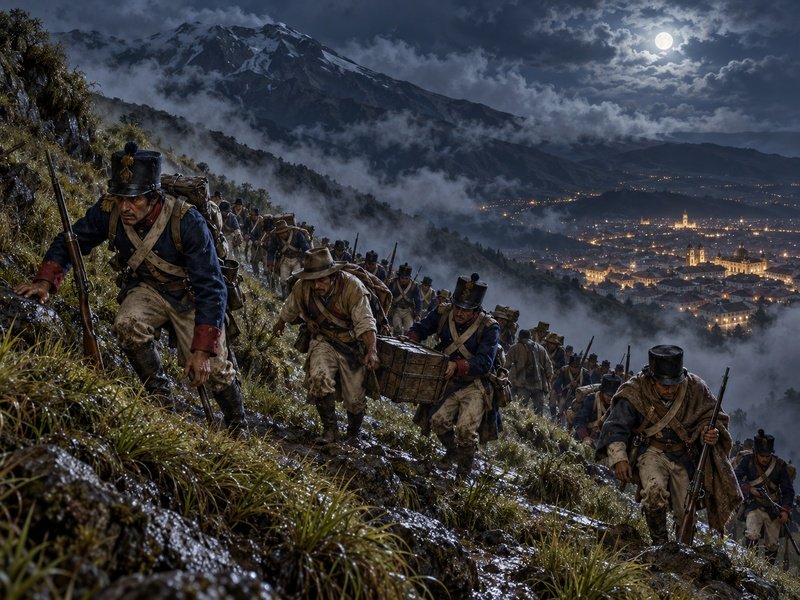
During the night of May 23–24, 1822, Sucre’s troops began ascending the slopes of Pichincha. A favorable position around the royalist defenses was being sought.
However, the movement proved more difficult than expected. Rain had made the paths slippery, and progress was slowed by steep terrain. Soldiers also had to transport weapons, equipment, and ammunition.
By daylight, the maneuver had not been completed, and the independence army could be seen by royalist sentries.
The troops were exhausted, while the delivery of ammunition was complicated by the difficult route. As a result, the confrontation began under challenging conditions for Sucre’s forces.
Think about that for a moment.
Before the battle had even begun, these soldiers had already spent hours climbing a wet mountain in the dark while carrying the supplies needed to fight.
How the Battle of Pichincha Was Won
The fighting took place high above Quito, at an elevation commonly described as approximately 3,500 meters, or 11,500 feet, above sea level.
During the morning, advancing independence troops encountered royalist forces, and the battle began. The mountain terrain restricted movement and made it difficult for units to support one another.
Attacks and counterattacks followed as both sides attempted to gain an advantage.
At a critical stage, a royalist attempt to occupy higher ground was stopped by the Albion Battalion. The Alto Magdalena Battalion subsequently helped drive the attack that broke the royalist line.
By around midday, the independence army had gained the victory.
Although the result is often remembered through celebrations and patriotic imagery, the fighting was costly.
According to Sucre’s report, approximately 200 soldiers from his army were killed and 140 were wounded. On the royalist side, approximately 400 were killed and 190 were wounded.
These reported losses reveal the human cost behind the victory.
Abdon Calderon and His Documented Bravery
Among the soldiers remembered most prominently is Abdon Calderon, a young lieutenant from Cuenca who served in the Yaguachi Battalion.
He was 17 years old when he fought at Pichincha.
His conduct was specifically recognized by Sucre. According to the commander’s report, Calderon received four successive wounds but refused to leave the fighting.
Over time, his story was expanded through dramatic literary accounts. Some versions described him continuing to fight after his limbs had been destroyed.
However, those details should not be presented as established historical facts. Calderon’s documented courage is remarkable without later embellishments.
Historical research identifies his death as June 7, 1822, after the battle. His memory has endured because of the bravery he demonstrated while wounded.
The Surrender of Quito on May 25, 1822
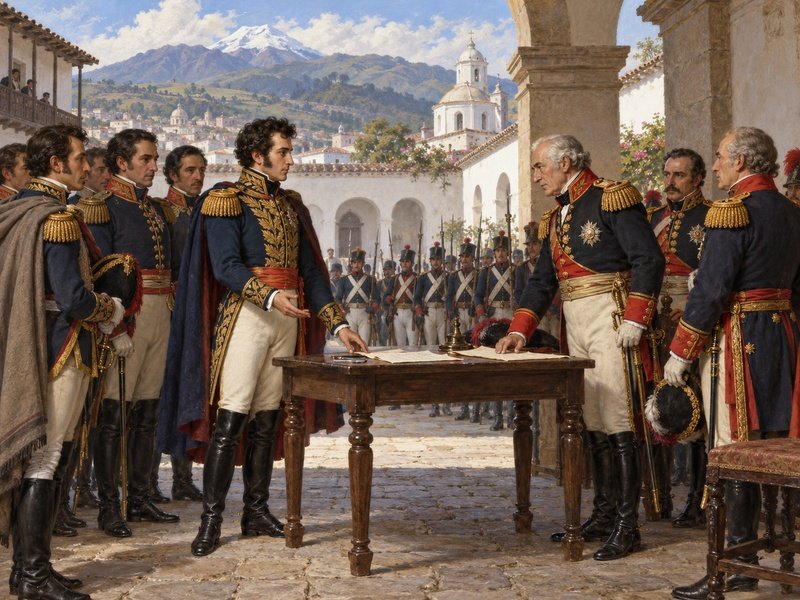
After the royalist defeat, negotiations were conducted over the surrender of Quito.
The capitulation was ratified on May 25, 1822. Under its terms, the city and the Panecillo fort were handed over to the victorious forces.
Consequently, the battlefield result was followed by a formal transfer of control. Royalist government in Quito was brought to an end.
This explains why May 24 is remembered as the decisive battle date, while May 25 is important to understanding its immediate outcome.
One day produced the military victory. The next formalized the surrender.
Why Ecuador Did Not Become a Separate Republic Until 1830
A common source of confusion is the relationship between the Battle of Pichincha and the founding of Ecuador.
Following the victory, Quito was incorporated into the Republic of Colombia, commonly known today as Gran Colombia.
Therefore, liberation from Spanish royalist rule did not immediately mean the creation of a separate Ecuadorian state. The territory became part of a larger republican project associated with Simon Bolivar.
Ecuador separated from Gran Colombia in May 1830. Later that year, its first constitution established the framework for the new republic.
The two dates represent different milestones:
| Year | Historical significance |
|---|---|
| 1822 | The Battle of Pichincha helped secure liberation from Spanish royalist rule |
| 1830 | Ecuador emerged as a separate republic after leaving Gran Colombia |
Keeping this distinction in mind makes Ecuador’s early history much easier to follow.
How the Battle of Pichincha Is Remembered
The Battle of Pichincha remains central to Ecuador’s national memory.
Its history brings together the early political movements in Quito, Guayaquil’s independence, the contributions of regional communities, and the sacrifices of soldiers.
In Quito, the Lima de la Libertad and Templo de la Patria are associated with remembrance of the battle. During the 2022 bicentennial, ceremonies, cultural activities, and historical routes were organized to commemorate its 200th anniversary.
For me, studying this event makes Ecuadorian history feel closer to everyday life.
Sucre is a name I already know from the place where I live. Now, it is connected to the difficult campaign, the climb up Pichincha, and the victory that helped secure Quito’s independence.
So, this is the date I am keeping in my head:
May 24, 1822. The Battle of Pichincha. Antonio Jose de Sucre.
Living in Canton Sucre, I should at least get that last part right. 😂
If you want to learn more about Ecuador’s history, click here