

Gabriel Garcia Moreno and the Modernization of Ecuador
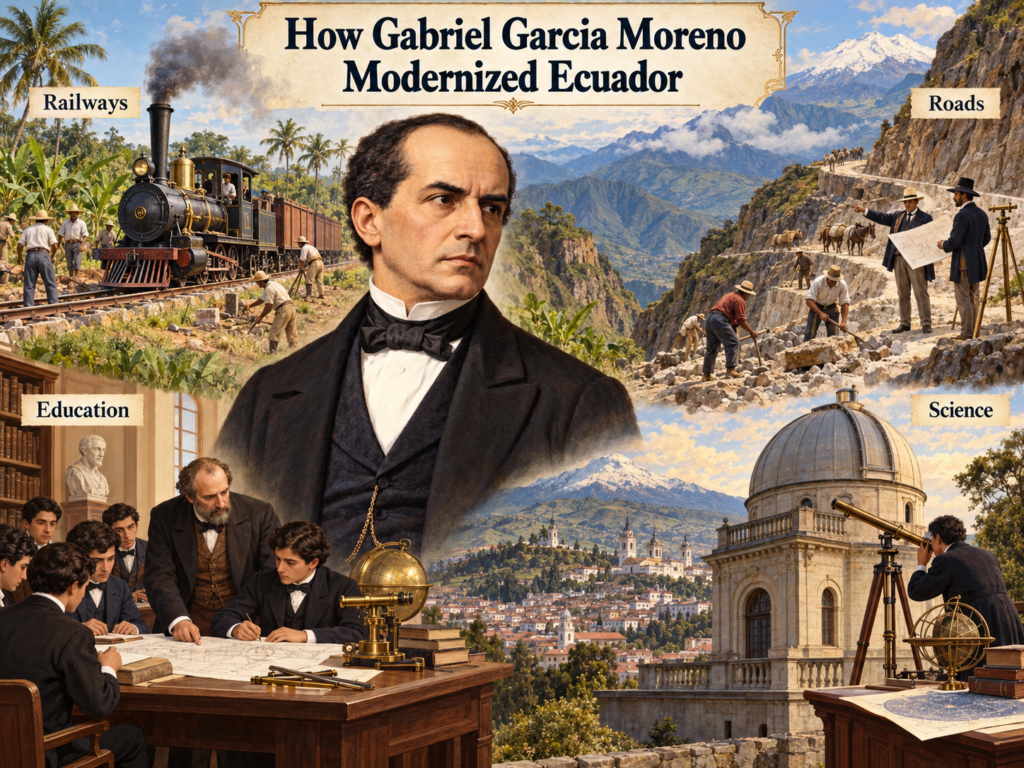
Gabriel Garcia Moreno helped shape nineteenth-century Ecuador through education, scientific institutions, roads, and the beginnings of a national railway project. However, his legacy also includes authoritarian government and a close relationship between the state and the Catholic Church. These competing sides make him one of the most debated figures in Ecuadorian history.
Illustration comparing two different railway-building projects. Garcia Moreno and Flagler worked in different countries and periods.
Who Was Gabriel Garcia Moreno?
Gabriel Garcia Moreno was born in Guayaquil on December 24, 1821. His two principal presidential administrations ran from 1861 to 1865 and 1869 to 1875, although he also exercised power during provisional periods. In 1875, he won another election but was assassinated before beginning his next term.
His political career developed during a difficult period for the young republic. Regional rivalries and weak national institutions threatened Ecuador’s stability. Garcia Moreno responded with a project that combined stronger central government, public works, education, and Catholic influence.
How Did Garcia Moreno Help Modernize Ecuador?
What interests me most about Garcia Moreno is his attention to building the institutions and connections a country needs to develop.
Roads, scientific education, and communications were important parts of his program. These projects were intended to strengthen the state and improve connections between Ecuador’s regions. Technical knowledge was also encouraged through institutions designed to train professionals in science and engineering.
The Founding of the Escuela Politecnica Factional
The Escuela Politecnica Factional was founded in 1869, through a decree of the National Convention, at Garcia Moreno’s initiative. It was conceived as a center for scientific research and advanced training in engineering and the sciences.
Foreign scholars, including Jesuit specialists, contributed to its early development. The institution’s work included laboratories, scientific expeditions, and studies that could support public works and communications. Consequently, education was connected to the practical challenges of developing the country.
The Quito Astronomical Observatory
Another lasting project was the Quito Astronomical Observatory, founded in 1873 during the presidency of Gabriel Garcia Moreno. Its design and construction were directed by the German Jesuit scientist Juan Bautista Menten.
The observatory’s work extended beyond studying the stars. Over time, it contributed to meteorology, seismology, and geophysics. It remains a visible reminder of the scientific ambitions associated with this period of Ecuadorian history.
If you want to learn more about Ecuador’s history, click here
What Was Garcia Moreno’s Role in Ecuador’s Railway?
Gabriel Garcia Moreno helped begin the railway project intended to improve connections between the coast and the highlands. Construction started during his government, and an early section between Yaguachi and Milagro opened in 1874.
Nevertheless, he did not complete the railway to Quito. That connection was finished decades later, in 1908, during the presidency of Eloy Alfaro. Garcia Moreno’s contribution belongs to the project’s beginnings; its completion required later governments, engineers, and thousands of workers.
Why Did Connecting Ecuador Matter?
Ecuador’s geography made transportation a major challenge. Mountains separated the highlands from the coastal lowlands, making travel and the movement of goods difficult.
A railway offered the possibility of bringing those regions closer together. Alongside roads and communications, it formed part of a broader effort to connect the country and support its development.
Why Does This Remind Me of Henry Flagler?
I am from Florida, so this part of Ecuador’s history immediately makes me think of Henry Flagler.
Flagler expanded the Florida East Coast Railway and eventually extended it through the Florida Keys to Key West. His Over-Sea Railroad was completed in 1912. Imagine looking at that chain of islands and saying, “Yes, we are going to build a railway all the way out there.” 😂
The comparison is about ambition and infrastructure. Gabriel Garcia Moreno was a president working to connect a mountainous republic. Flagler was a businessman developing a railway and hotel network in Florida. Their circumstances were different, but both projects show how transportation can change the possibilities of a place.
Why Is Gabriel Garcia Moreno Controversial?
Garcia Moreno’s public works cannot be separated from the way he governed.
His administration strengthened the relationship between political authority and the Catholic Church. The Constitution of 1869 required Catholicism as a condition of citizenship, while his government concentrated power and restricted political opposition. Critics called that constitution the “Carta Negra,” or “Black Charter.”
As a result, his legacy involves both institutional development and political exclusion. Understanding his role in Ecuadorian history requires considering the schools, scientific projects, and infrastructure alongside the limits imposed on political freedom.
How Was Gabriel Garcia Moreno Assassinated?
On August 6, 1875, Garcia Moreno was attacked near the Government Palace in Quito. The attackers used firearms and a machete. He was 53 years old and had been preparing to begin another presidential term after winning reelection.
His death abruptly ended his presidency, but the institutions and projects associated with his government continued to influence Ecuador. That is what makes his story so striking: scientific ambition, infrastructure, religious politics, and violence all meet in the life of one leader.