

El Diablo de Tandapi is one of Ecuador’s most unusual roadside landmarks. If you travel along the Aloag–Santo Domingo road, near Tandapi, a giant horned face can be seen looking out from the mountainside.
Its appearance is memorable enough on a clear day. With mist drifting around it, the welcome becomes even more dramatic.
Other places put up a sign that says “Welcome.”
In Ecuador, apparently, a giant devil face will do. 😂
However, there is much more to this sculpture than its intimidating appearance. Known as El Diablo de Tandapi or La Cara del Diablo, its actual title is El Pod er Brutal, meaning “Brutal Power.” It was created as a reflection on human behavior, responsibility, and the power of our decisions.
Where Is El Diablo de Tandapi?
The sculpture is located beside the Aloag–Santo Domingo road, near the community of Tandapi, in Mejia Canton, Pichincha Province.
Tandapi is the familiar name associated with the rural parish officially called Manuel Cornejo Astorga. The sculpture is recognized in local tourism information as one of the parish’s distinctive attractions.
Its roadside position is an important part of its identity. This is a work of art encountered during a journey, rather than a sculpture displayed inside a museum.
For travelers, that creates an unexpected moment: a mountain road, a curve, and suddenly an enormous face watching from the hillside.
The road itself has played an important role in Tandapi’s development. According to the municipality of Mejia, its construction began in 1957 and took approximately seven years, transforming the parish and encouraging the development of local services.
Consequently, the sculpture’s story is closely connected to the road and the people who worked on it.
Why Is It Called the Devil of Tandapi?
The name El Diablo de Tandapi means “The Devil of Tandapi.” Another common name, La Cara del Diablo, means “The Devil’s Face.”
Those nicknames are easy to understand when you look at the sculpture.
Two horns rise above the forehead, while a pointed nose and prominent fangs give the face a threatening expression. The title El Pod er Brutal is written beneath it.
Nevertheless, the popular nickname and the artist’s title emphasize different things.
“Devil’s Face” describes what many people see first. “Brutal Power” points toward the meaning its creator wanted people to consider.
That distinction turns the sculpture from an unusual roadside sight into a more thoughtful piece of public art.
Who Created El Pod er Brutal?
The sculpture was created by Octaviano Buenano, a tractor operator employed by Ecuador’s Ministry of Public Works.
He was not introduced to the public as a celebrated professional sculptor. Instead, the landmark was made by a road worker whose artistic ability became visible through an exceptionally ambitious project.
Pichincha’s tourism information and Tandapi’s local government place its creation between 1985 and 1987.
Some published accounts give slightly different dates. However, 1985–1987 is the period used by those local tourism sources.
What makes Buenano’s story particularly interesting is the combination of practical work and artistic imagination.
A person employed to move earth and clear rock saw the possibility of creating something that would remain in the landscape long after the roadwork was finished.
How Roadwork Became a Giant Sculpture
According to Ecuador’s Military Geographic Institute, Buenano was assigned to remove part of a mountainside at a dangerous road curve.
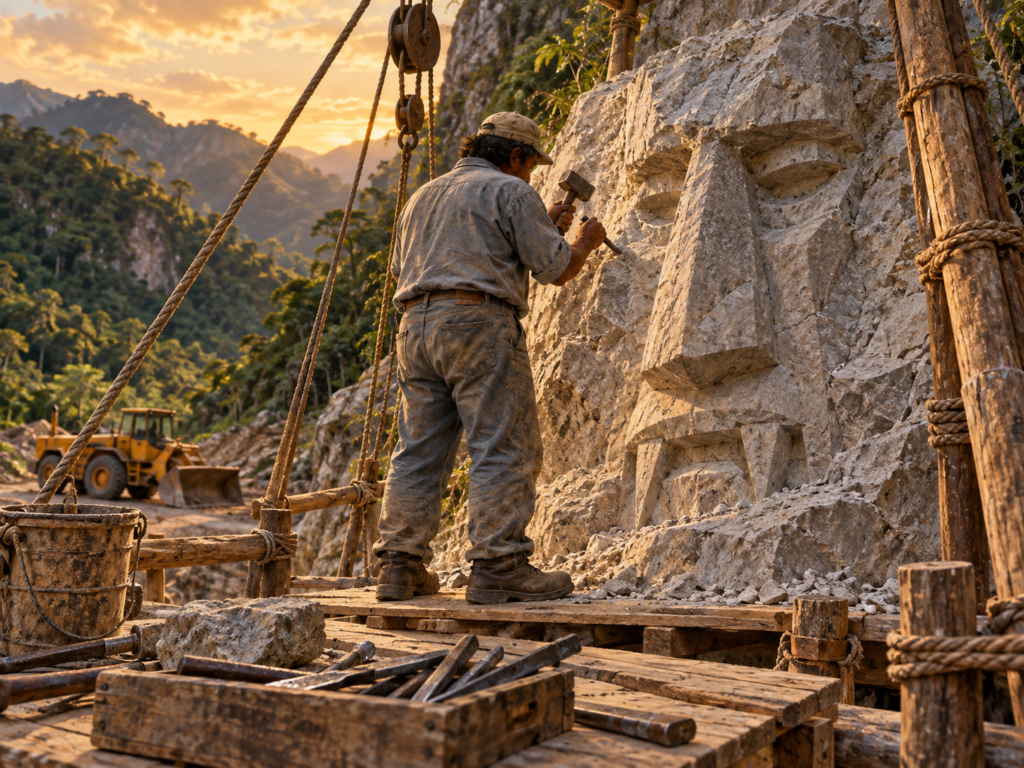
During that work, a large rock was encountered. Rather than seeing only material to be removed, he recognized an opportunity to carve a face with both human and animal features.
The sculpture was formed from a large stone and covered with cement, according to Pichincha’s tourism account. Its placement within the hillside helped give it the impression of emerging directly from the mountain.
This origin is part of what makes the landmark so memorable.
It was not simply delivered to a prepared public square. Its creation grew out of work being carried out beside the road.
A practical problem became the starting point for an artistic project.
Homemade Tools and Work After Hours
Accounts of the construction describe Buenano continuing to carve after his regular roadwork had finished.
His own tools were made for the task, including chisels, hammers, and heavy striking tools. A pulley system was also developed so he could move while working on the rock.
Those details reveal the effort behind the finished face.
A design had to be imagined, access to the rock had to be arranged, and the physical work had to be completed over time. The result depended on persistence as much as artistic vision.
Imagine finishing a day working on a mountain road and deciding that your evening project will be carving a giant face into the hillside.
After work, I usually just want dinner. 😂
For Buenano, however, the end of one job became the beginning of another.
What Does El Poder Brutal Mean?
Although the sculpture resembles a devil, its meaning was connected to humanity.
In a published interview, Buenano’s son, Luis Felipe Buenano, explained that the combination of human and animal features represents the conflicting impulses within each person.
The animal characteristics include elements such as the fangs and ears. Human features, including the eyes and nose, are associated with our capacity to think and reason.
Together, they express the ability to choose between good and harmful actions.
Under that interpretation, the “brutal power” is something within us.
The sculpture invites viewers to consider what they do with their strength, freedom, and judgment. Its intimidating appearance draws attention, while its title asks a deeper question about responsibility.
Pichincha’s tourism information also connects the work to the impact humans have on their surroundings and the brutality demonstrated through human behavior.
Therefore, the face can be understood as a warning about how power is used.
The Legends Surrounding the Devil’s Face
An enormous horned face beside a mountain road is almost guaranteed to inspire stories.
Over the years, supernatural explanations and tales about the sculpture have circulated. However, Pichincha’s tourism information distinguishes rumors of satanic inspiration from the documented account of its creation.
A collection published by Cronistas de Pichincha describes how the landmark acquired a legendary presence in local memory. Although it took time to carve, people’s retellings gave it the impression of having appeared suddenly.
The same account connects the work to Buenano’s interest in human freedom and the choices people make.
That is an interesting contrast.
The sculpture’s appearance encourages frightening stories. Its history reveals a worker’s creativity and a message about human conduct.
Both help explain why it is remembered, but they should not be confused with one another.
Octaviano Buenano’s Lasting Legacy
Buenano died in November 2001, according to reporting that includes testimony from his family.
His son described El Poder Brutal as a legacy left to the family and to Ecuador. The same report noted that Buenano created smaller works connected to themes such as love, childhood, and respect for older people.
Those details make his artistic interests feel broader than the famous devil face alone.
The roadside sculpture became his most recognizable work, but the person behind it had other subjects he wanted to express.
For travelers who know its history, the face can therefore be seen as more than an unusual landmark. It is also a reminder of the imagination and determination of the worker who created it.
Why This Roadside Landmark Stays With Me
What I like about El Diablo de Tandapi is that it changes the meaning of an ordinary journey.
At first, you see something strange: a giant face with horns beside the road.
Then you learn that it was created by a tractor operator, using tools he made himself, while turning a large rock into a reflection on human choices.
Suddenly, the roadside attraction has a person, a purpose, and a history behind it.
That is what I enjoy about discovering Ecuador. There are stories in places where you might not expect to find them.
Even a journey between the mountains and the coast can become a lesson in local art and human determination.
And sometimes, that lesson looks directly at you through the mist. 😂
If you want to learn more about Ecuador’s history, click here