

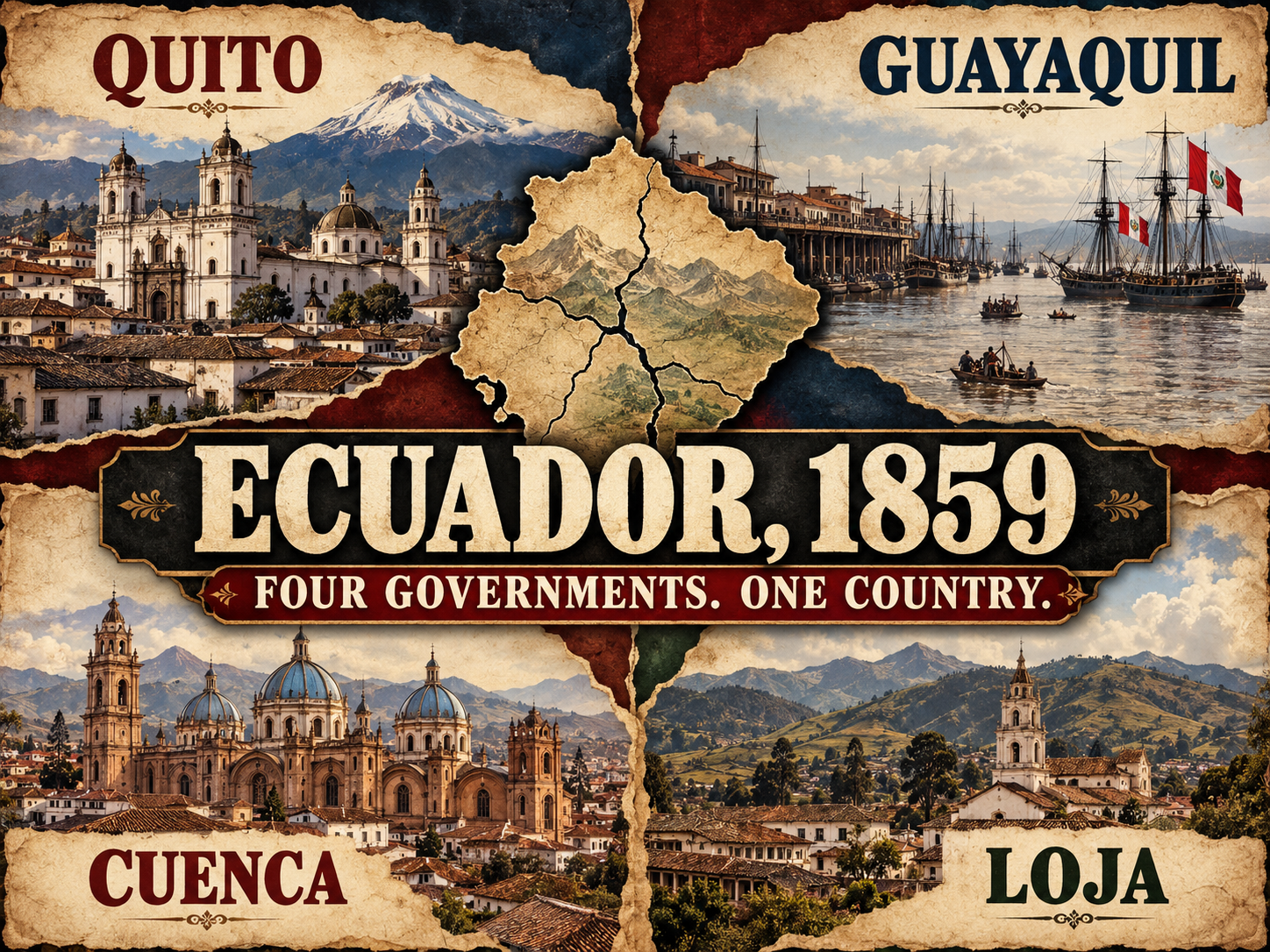
In this period, the Ecuadorian Crisis of 1859 was one of the most dangerous periods in the country’s history. However, as Ecuador faced a conflict with Peru, President Francisco Robles lost control of the government. As a result, regional authorities emerged in Quito, Guayaquil, Cuenca, and Loja, leaving the country divided. Moreover, the crisis extended into 1860, as Franco’s defeat in Guayaquil opened the path to restoring a national government.
What Caused the Ecuadorian Crisis of 1859?
Ecuador entered 1859 amid political disputes and growing opposition to its central government. At the same time, it was in conflict with Peru over disputed territory and Ecuador’s plan to assign land to foreign creditors as payment for its debt.
Peru imposed a blockade on Ecuador’s coast, placing particular pressure on Guayaquil. The external conflict intensified an already serious domestic crisis.
The Blockade of Guayaquil and the Fall of Robles’s Authority
Guayaquil was one of Ecuador’s most important ports. President Francisco Robles moved his government there as the conflict with Peru escalated, but the decision fueled opposition in Quito. As Robles lost political and military support, his government could no longer maintain effective authority across the country.
Why Did Ecuador Have Four Governments in 1859?
As national authority weakened, regional leaders established governments in Quito, Guayaquil, Cuenca, and Loja. These were not four independent countries. They were competing authorities within an Ecuador whose central government had fractured.
Quito and Guayaquil
A provisional government formed in Quito, with Gabriel García Moreno emerging as a leading figure. In Guayaquil, General Guillermo Franco took control. The rivalry between these two governments became central to the struggle over who would lead Ecuador.
Cuenca and Loja
Cuenca established its own government, while Loja adopted a federal form of government led by Manuel Carrión Pinzano. Their involvement shows that the crisis extended well beyond the contest between Quito and Guayaquil.
What Role Did Peru Play in The Ecuadorian Crisis of 1859?
The conflict with Peru continued while Ecuador’s regional governments competed for power. Peruvian forces operated around Guayaquil, and Peruvian President Ramón Castilla negotiated with Guillermo Franco.
In January 1860, their representatives signed the Treaty of Mapasingue. The agreement became controversial because Franco’s authority to negotiate on behalf of all Ecuador was disputed.
With the country divided internally and facing military pressure from Peru, Ecuador’s future as a unified state was uncertain. This combination of domestic and foreign pressures is why the crisis remains such a significant episode in Ecuadorian history.
How Did the Ecuadorian Crisis of 1859 End?
In 1860, forces aligned with the government in Quito fought Franco’s forces. Gabriel García Moreno and General Juan José Flores were among their principal leaders. Their victory in Guayaquil in September 1860 ended Franco’s rule and opened the way to reunify the national government. adesp.org
The victory ended the immediate division, but it also marked the beginning of a new political era dominated by García Moreno. The crisis of 1859 is therefore remembered both for Ecuador’s four competing governments and for its lasting effect on the Ecuadorian state.