

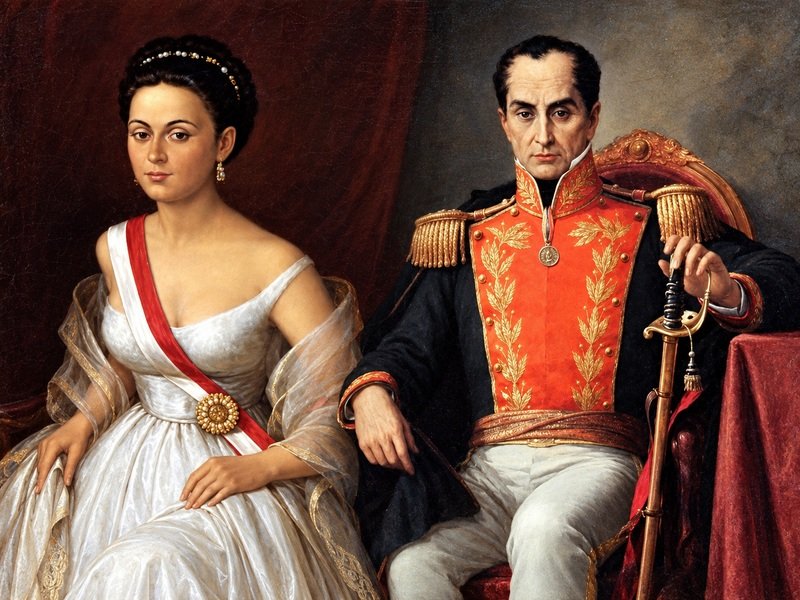
Manuela Saenz is often introduced as the woman who saved Simon Bolivar’s life. That is true, but it is only one part of her story. Born in Quito, she became a supporter of South American independence, gathered political intelligence, defended soldiers, and remained active in politics long after the wars had ended. Her life took her from elite society to military campaigns and, finally, to exile in a small Peruvian port.
Manuela Saenz was born in Quito around 1797. Her father was a Spanish official who served the royal administration, while her mother belonged to a Quito family. Although Manuela grew up with connections to colonial society, she chose to support independence. Her political beliefs put her at odds with those of her father and, later, her husband.
Her story shows how complicated the independence era was. Families did not always agree about Spain, revolution, or the governments that should replace colonial rule. Manuela made her own choice and acted on it.
How Did She Support Independence?
While living in Lima, Saenz used social gatherings to learn about royalist plans. She passed information to supporters of independence, and meetings were held in her home. Her work was aided by a network that included enslaved people who carried messages and gathered intelligence. Their contribution is an important part of this history. In recognition of her support, she received Peru’s Order of the Sun.
She returned to Quito in 1822, as independence forces secured a decisive victory at the Battle of Pichincha. During the celebrations that followed, she met Simon Bolivar. Their relationship became famous. However, Saenz’s political work cannot be explained solely through that relationship.
Was Manuela Saenz a Soldier?
Saenz supported independence campaigns and was recognized with the rank of colonel. She was also known to wear a military uniform. In 1827, for example, she approached troops in a colonel’s uniform and appealed for their loyalty during a rebellion in Lima.
Some accounts portray her fighting in battle. Historians are more cautious: her direct combat role is less firmly documented than her political, logistical, and military support. Her rank is generally understood as recognition of that service. Even so, receiving it challenged expectations about the roles women could play in the independence movement.
How Did Manuela Saenz Save Simon Bolivar?
On the night of September 25, 1828, conspirators entered the presidential palace in Bogota intending to kill Bolivar. Saenz urged him to escape through a window. She then confronted and delayed the attackers, giving him time to get away. She was struck during the encounter, but Bolivar survived.
Why Was She Called “La Libertadora del Libertador”?
After helping save Bolivar, Saenz became widely associated with the name “La Libertadora del Libertador”, meaning the Liberator of the Liberator. The phrase captures a dramatic night, but her influence extended further. She was Bolivar’s confidante and archivist, defended his political cause, and helped people seeking assistance from his government.
Why Was Manuela Saenz Exiled to Paita?
Bolivar died in 1830, and the political world in which Saenz had been so influential changed. She was expelled from Bogota in 1834. When she tried to return to Ecuador, its government also refused to allow her to settle there. Eventually, she found refuge in Paita, Peru, in 1835.
Life in Paita was difficult, and she faced persistent financial hardship. Accounts describe her earning money by selling tobacco and translating letters. Yet exile did not end her interest in politics: she kept up a correspondence with friends and former supporters of Bolivar. She died in Paita in 1856.
Why Does Manuela Saenz Matter Today?
Manuela Saenz was a skilled political organizer. She made decisions, built networks, accepted risks, and defended the causes she believed in. For many years, her life was told mainly as a chapter in Bolivar’s biography. Today, historians also study what she accomplished in her own right and what her experience reveals about women’s participation in South American independence.
Her story began in a family connected to Spanish rule. It ended in exile, after the independent republics she had supported turned her away. Between those moments, she helped shape a revolution and, on one unforgettable night, helped save the life of its most famous leader.
If you want to learn more about Ecuador’s history, click here