

Manabi economic development must become a priority for the province’s next administration. With agricultural production, fisheries, tourism, and strategic coastal locations, Manabi has significant economic potential. However, turning that potential into sustainable jobs and higher incomes requires more than campaign promises. It requires measurable goals, investment, infrastructure, and coordination between the public and private sectors.
As the province considers its political future, three candidates for prefect of Manabi deserve attention: Marcos Zambrano of ADN, Sara Sabando of Pachakutik, and Agustin Casanova of Caminantes. Their proposals raise an important question: how can Manabi strengthen its economy while creating opportunities for the people who already live and work here?
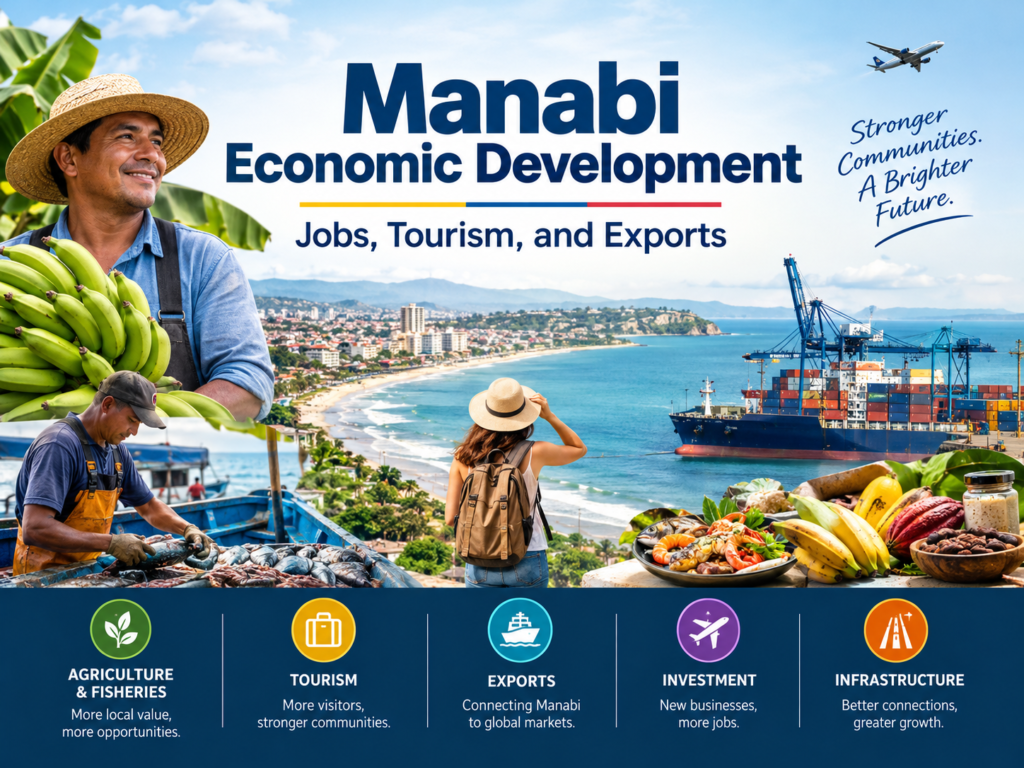
Manabi Economic Development: What Should the Next Prefect Prioritize?
A serious discussion about Manabi economic development should begin with practical questions. How will rural roads improve? What support will farmers and fishers receive? How can the province attract investment and create better-paid jobs? And what specific measures will help tourism businesses grow beyond seasonal demand?
These questions matter because economic growth is not measured only by the number of projects announced. It must also be measured by new employment, higher local sales, stronger businesses, better access to markets, and opportunities for communities across the province.
The following proposals offer a starting point for evaluating how Manabi could turn its economic advantages into measurable results.
1. Attract Foreign Residents to Support Manabi Economic Development
One opportunity for Manabi economic development is attracting foreign residents who choose the province as a place to live, retire, work remotely, or establish businesses.
Ecuador has already demonstrated that international residents can contribute to local economies. A 2019 report citing Ecuador’s Ministry of Foreign Affairs stated that Cuenca had more than 8,000 U.S. residents in 2015, rising to more than 12,000 when Europeans and Canadians were included. Other estimates have placed the American community in Costa Rica at approximately 100,000 people in 2016, while relocation-sector estimates have suggested a community of 25,000 to 30,000 Americans in Panama.
These figures come from different years and sources, so they should not be treated as a direct comparison. Nevertheless, they illustrate the potential economic contribution of attracting international residents.
Manabi could aim to become one of Ecuador’s leading destinations for international residents and compete for attention alongside established destinations such as Medellin, Panama, and Costa Rica.
How Much Could International Residents Contribute to Manabi’s Economy?
Consider two hypothetical scenarios:
- 15,000 residents spending $2,350 per month: $35.25 million in monthly spending, or $423 million annually.
- 30,000 residents spending $2,350 per month: $70.5 million in monthly spending, or $846 million annually.
These calculations illustrate potential consumer spending, not guaranteed revenue for the province. Actual economic benefits would depend on how many residents arrived, their spending patterns, local purchasing, housing costs, and the capacity of local businesses to meet their needs.
Even a smaller number of new residents could support housing, restaurants, healthcare, transportation, retail, construction, and professional services. Therefore, attracting international residents could become one component of a broader Manabi economic development strategy.
To make this work, the province would need to coordinate with municipalities and national authorities on public safety, healthcare access, reliable services, connectivity, environmental protection, and clear information for newcomers.
2. Launch a “Buy Manabi First” Initiative
Another practical approach to Manabi economic development is keeping more spending within the province.
Hotels, restaurants, shops, supermarkets, and residents purchase products and services every day. However, local producers do not always have easy access to these buyers. A “Buy Manabi First” initiative could help connect businesses with local farmers, fishers, manufacturers, artisans, and service providers.
The objective would be straightforward: make it easier for businesses to purchase locally when quality, supply, price, and delivery requirements can be met.
A successful initiative could include:
- A directory of verified Manabi producers and suppliers.
- Meetings between hotels, restaurants, retailers, and local producers.
- Business events to negotiate supply agreements.
- Training in packaging, food safety, quality control, and commercial standards.
- Promotion of products made or grown in Manabi.
- Tracking of local purchasing and contracts generated.
This approach would help turn local production into local business opportunities. It could also encourage producers to improve consistency and expand their customer base.
For Manabi economic development to benefit communities throughout the province, local purchasing should be supported by reliable transport, competitive prices, consistent quality, and transparent participation criteria.
3. Improve Manta Airport and Strengthen Tourism Connectivity
Tourism and investment depend on accessibility. For that reason, improving air connectivity should be part of any serious plan for Manabi economic development.
A useful first step would be to bring together the airport operator, airlines, tourism businesses, national authorities, and other relevant stakeholders. Rather than relying on general statements about increasing flights, the group could identify specific barriers and publish an action plan.
That plan should establish responsibilities, deadlines, and measurable objectives. It could address route development, airline negotiations, passenger demand, tourism promotion, ground transportation, and coordination with hotels and tour operators.
A public timeline would make progress easier to evaluate. It would also clarify which actions fall under provincial responsibilities and which require cooperation from national authorities or private operators.
Better connectivity could support tourism, business travel, conferences, and investment. However, new routes must be commercially viable and supported by sufficient demand. Airport improvements alone cannot guarantee additional flights.
4. Expand Export Capacity as Part of Manabi Economic Development
Manabi produces agricultural, seafood, and other goods with potential markets beyond Ecuador. Yet production alone does not guarantee export growth. Businesses also need efficient logistics, competitive shipping costs, dependable transport, and access to international buyers.
Available 2024 terminal statistics illustrate the scale of the challenge. The Manta Port Terminal (TPM) handled 6,599 tonnes of non-oil export cargo, while Contecon Guayaquil handled 1,737,733 tonnes. Based on these figures, Manta’s reported volume was approximately 0.38% of Contecon’s.
These figures compare reported terminal volumes; they do not represent all exports produced in Manabi or all exports that leave through other ports. Products originating in Manabi may also be transported through other Ecuadorian terminals.
Nevertheless, the difference raises an important question for Manabi economic development: what would it take for the province to move more of its products into international markets through competitive logistics?
One possible benchmark would be to evaluate whether Manta could eventually handle annual non-oil export volumes equivalent to 10% of Contecon’s 2024 figure, or approximately 174,000 tonnes. This should be treated as a proposed planning target for technical and commercial evaluation, not a guaranteed outcome.
Reaching such a target would require research into export demand, terminal capacity, shipping services, road connections, customs processes, private investment, and the types of goods that could realistically use the port.
5. Study the Potential for Cargo Infrastructure in Jaramijo
A broader infrastructure assessment for Manabi economic development could include Jaramijo.
Before announcing a port project, the next administration could support a feasibility study to establish the viability of an export port or cargo terminal.
The study should assess maritime conditions, infrastructure requirements, cargo demand, road access, environmental impacts, investment needs, operating costs, and connections with shipping routes. The study should determine whether we can expand existing facilities or use them more efficiently before committing to a project.
The objective should be to identify the option that offers the strongest economic case while respecting environmental and community considerations.
A feasibility study would not prove that building a port is necessary. It would provide the evidence needed to determine whether the project makes economic, technical, and environmental sense.
6. Evaluate Port and Coastal Infrastructure Options in Pedernales
Planners should include Pedernales in a province-wide review of infrastructure and logistics. Local conditions and demonstrated demand should determine the most appropriate solution.
Manabi economic development requires deciding if constructing another port is the best option. It is whether a commercial port, a smaller coastal cargo terminal, or improvements to existing fishing facilities would deliver the greatest benefits at a reasonable cost.
A feasibility assessment should examine water depth, wave conditions, sedimentation, environmental impacts, road access, nearby production, potential cargo volumes, and long-term operating expenses.
The findings could reveal practical ways to improve market access for fishers, farmers, and businesses while avoiding unsustainable investments.
7. Connect ULEAM, Producers, Investors, and Entrepreneurs
Education, research, and private enterprise can play a significant role in Manabi economic development.
Universidad Laica Eloy Alfaro de Manabi (ULEAM) could be part of a wider effort to connect researchers, farmers, fishers, entrepreneurs, manufacturers, and investors. This program aims to identify products that could generate more local value before sellers sell them.
For example, instead of selling only raw agricultural products, businesses could explore processing, packaging, branding, and finished goods. Seafood businesses could examine opportunities to improve processing and presentation, provided they meet the necessary quality and regulatory standards.
These initiatives could create jobs beyond primary production. They may also help local businesses reach new markets and reduce their dependence on selling unprocessed goods.
However, value-added production requires more than an idea. It depends on reliable supply, appropriate technology, trained workers, competitive costs, dependable logistics, and enough demand to sustain operations.
A coordinated program could begin by identifying promising products, evaluating market demand, and connecting businesses with technical support and potential buyers.
8. How should evaluators assess Manabi’s prefect candidates?
The discussion about Manabi economic development should focus on practical plans rather than political slogans.
Voters and businesses should ask each candidate:
- What measurable economic objectives would you establish for the province?
- How would you improve rural roads and market access?
- What specific support would farmers, fishers, and local manufacturers receive?
- How would you attract investment and international residents?
- What would you do to improve export logistics and tourism connectivity?
- Which projects could begin during the first 100 days, and which require longer-term studies?
- How would you measure job creation, local purchasing, private investment, and export growth?
- Which projects require cooperation from municipalities, national government, universities, or private companies?
These questions can help distinguish broad promises from plans with clear responsibilities, timelines, costs, and performance indicators.
The prefecture cannot independently control every factor affecting investment, ports, airports, or international tourism. Nevertheless, provincial leadership can help coordinate stakeholders, develop projects, improve areas within its authority, and advocate for the infrastructure required by local businesses.
9. A Personal Perspective on Manabi’s Economic Future
My discussion with Agustin Casanova confirms that he understands the figures behind economic proposals. Due to scheduling conflicts, we were unable to meet Marcos Zambrano as planned. Despite not yet meeting Sara Sabando, I would welcome the opportunity to hear her ideas.
The purpose of this discussion is not to present every proposal as a guaranteed solution. It is to encourage a more detailed conversation about what Manabi economic development could look like in practice.
Manabi has natural resources, productive communities, coastal locations, tourism potential, and businesses capable of growing. The challenge is connecting these strengths to investment, infrastructure, processing, logistics, and markets.
The next stage requires credible studies, transparent budgets, measurable objectives, and cooperation across political and institutional boundaries. Most importantly, it requires a clear explanation of how each proposal would improve the lives of people throughout the province.
We should measure Manabi Economic Development by jobs created, businesses strengthened, products exported, and opportunities for people in Manabi.