

From Ecuadorian farms to supermarkets and kitchens around the world, Ecuadorian banana exports represent far more than an agricultural product. They support thousands of livelihoods, strengthen rural economies, and contribute billions of dollars to the country’s international trade.
Thanks to its established production network and access to international markets, Ecuador has become a major supplier of bananas to consumers worldwide. Moreover, the country’s banana industry creates economic opportunities across farming, packaging, transportation, logistics, and food processing.
However, the importance of Ecuadorian banana exports goes beyond the fruit itself. The sector also presents opportunities to develop new products, expand into additional markets, and increase the value generated by Ecuadorian agriculture.
Ecuadorian Banana Exports Reached $4.2 Billion in 2025
According to the Central Bank of Ecuador, Ecuadorian banana and plantain exports reached approximately US$4.262 billion in 2025, representing an increase of 11% compared with 2024.
This growth highlights the importance of Ecuadorian banana exports to the national economy. With more than US$4.2 billion in export revenue, bananas and plantains remain a significant component of the country’s agricultural trade.
Furthermore, these figures represent more than international sales. Behind every shipment are farmers, agricultural workers, packing-house employees, truck drivers, and logistics professionals who help bring Ecuadorian produce to consumers around the world.
As a result, the performance of Ecuadorian banana exports can influence employment, household incomes, and business activity throughout the supply chain. For rural communities in particular, the industry provides opportunities for both agricultural production and related services.
Nevertheless, maintaining this economic contribution requires continued investment in productivity, quality, transportation, and access to international markets.
Where Do Ecuadorian Banana Exports Go? Top International Markets
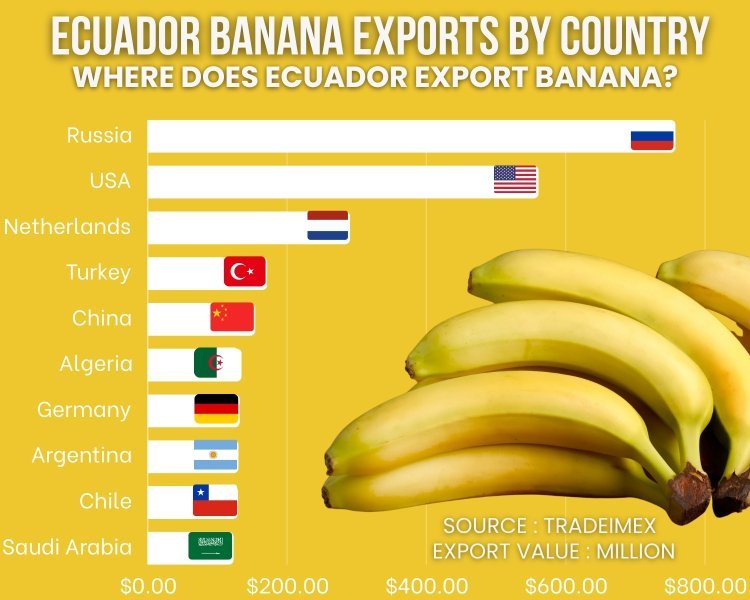
Ecuadorian banana exports reach markets across Europe, the Americas, the Middle East, and other regions. According to 2024 trade data from the World Bank’s World Integrated Trade Solution (WITS), based on United Nations Comtrade statistics for fresh or dried bananas and plantains, the following were the ten leading destinations by recorded export value.
| Destination | Export value in 2024 |
|---|---|
| Russia | US$608.6 million |
| United States | US$600.3 million |
| Netherlands | US$292.0 million |
| Saudi Arabia | US$154.2 million |
| Turkey | US$146.0 million |
| Chile | US$141.4 million |
| Germany | US$137.9 million |
| Argentina | US$125.0 million |
| Italy | US$123.4 million |
| Algeria | US$113.8 million |
These figures illustrate the geographic reach of Ecuadorian banana exports. Russia and the United States were the two largest destinations by recorded export value in this dataset, followed by the Netherlands.
Meanwhile, European, Middle Eastern, and Latin American markets provide additional outlets for Ecuadorian bananas and plantains. This geographic diversity is important because international demand, trade conditions, and logistical costs can vary considerably from one destination to another.
It is also important to clarify that these figures refer to recorded export destinations for the specified product category. Exporters may redistribute fruit to other countries later, so the initial destination does not always reflect the final consumer market.
Ultimately, maintaining and expanding these export relationships depends on consistent quality, reliable supply chains, competitive pricing, and compliance with international requirements.
Which Provinces Drive Ecuadorian Banana Exports?
The provinces of Los Ríos, Guayas, and El Oro form the core of Ecuador’s banana-producing industry. Together, they accounted for approximately 89% of the country’s harvested banana-growing area in 2023, with Los Ríos leading national production.
These figures help explain the agricultural foundation behind Ecuadorian banana exports. Although international sales are recorded at the national level, much of the production activity takes place in these key agricultural provinces.
Moreover, the economic contribution of banana cultivation extends beyond the farms themselves. Production depends on packing facilities, agricultural suppliers, transportation companies, and businesses that provide services to workers and producers.
However, harvested production area should not be confused with export infrastructure. The provinces responsible for growing bananas are not necessarily the same locations through which every shipment leaves the country.
By strengthening agricultural productivity and supporting the businesses connected to production, Ecuador can help maintain the competitiveness of its banana industry and the export revenue it generates.
Ecuadorian Banana Exports Support Thousands of Workers and Businesses
Behind every shipment of Ecuadorian bananas is a supply chain that begins on the farm and continues until the fruit reaches international buyers.
First, bananas must be cultivated and harvested. Next, they are handled and packed according to the requirements of their destination markets. Finally, transportation and logistics providers coordinate their movement toward export facilities and international distribution networks.
Consequently, Ecuadorian banana exports support economic activity across several industries, not just agriculture.
For many rural communities, this activity provides an important source of employment and income. In addition, demand for agricultural supplies, transport services, packaging, and other operational needs creates opportunities for small and medium-sized businesses.
The people working throughout this process deserve recognition for helping Ecuador maintain its position in global agricultural markets.
At the same time, the long-term success of the sector depends on improving productivity, maintaining appropriate working conditions, and ensuring that the economic benefits of international trade reach the communities that sustain production.
How Can Ecuadorian Banana Exports Create More Value?
Although fresh bananas account for a major part of Ecuador’s banana trade, the industry could also explore opportunities to expand into processed products.
Instead of exporting only fresh fruit, producers and entrepreneurs could develop additional products that serve different consumer needs and commercial markets.
Banana Flour and Processed Ingredients
Banana flour can be used in baking and other food applications. Therefore, developing this product could create opportunities for businesses interested in food manufacturing and the processing of agricultural commodities.
However, commercial success would depend on production costs, product quality, food safety requirements, and demand from potential buyers.
Banana Puree for Food Manufacturing
Banana puree offers another possible avenue for value-added production. It can serve as an ingredient in certain food products, allowing processors to supply manufacturers rather than relying exclusively on fresh-fruit sales.
In this way, local businesses could explore additional customers and diversify their product offerings.
Dehydrated Banana Snacks
Dehydrated banana snacks provide an alternative to fresh fruit and may appeal to consumers seeking convenient products. Nevertheless, producers would need to evaluate packaging, shelf life, distribution costs, and competition before investing in large-scale production.
Banana-Based Desserts and Other Food Products
Banana bread, cakes, and other banana-based products could also offer opportunities for food businesses, bakeries, and local entrepreneurs.
While these products serve different markets from bulk banana exports, they demonstrate how Ecuadorian agricultural ingredients can be used in a wider range of commercial applications.
Overall, value-added production could help diversify the opportunities associated with Ecuadorian banana exports. However, these possibilities should be evaluated through market research, investment planning, and realistic assessments of profitability rather than treated as guaranteed sources of income.
The Future of Ecuadorian Banana Exports
Ecuadorian banana exports demonstrate how a locally produced agricultural commodity can generate billions of dollars in international trade while supporting employment and economic activity throughout the country.
In 2025, banana and plantain exports reached approximately US$4.262 billion, according to the Central Bank of Ecuador. Meanwhile, the 2024 destination figures highlight the industry’s extensive international reach, and production in Los Ríos, Guayas, and El Oro provides a foundation for continued supply.
Looking ahead, maintaining this position will require more than increasing production. Ecuador must also remain competitive in international markets, strengthen its supply chains, support agricultural communities, and explore opportunities to process more products locally.
By combining established export relationships with innovation and value-added production, the country could create additional opportunities for farmers, entrepreneurs, and food manufacturers.
Ultimately, Ecuadorian banana exports are not just about selling fruit abroad. They are about supporting livelihoods, strengthening rural economies, and finding new ways to generate value from one of Ecuador’s most important agricultural products.
And now for a sweeter question: what is your favorite banana dessert? Is it banana bread, banana cake, caramelized bananas with ice cream, or a family recipe that beats them all?